 Great to see Pat Terry writing in the Chicago Tribune about the myth of buying organic at a farmers market.
Don’t get me wrong, I’m a huge supporter of farmers markets (you can catch me on occasional Saturdays at the Oak Park Farmers Market info booth). But she’s right to say that many food buyers are likely under the false impression that what they’re buying is organic.
Not likely. Indeed, I’d argue that focusing on certified organic is a waste of time at this point. Organic certification has become so cumbersome, so parsed in regulation, that the best strategy, from my perspective, is to know your farmer personally. Know how he/she works the land, manages pests and whether the farm is working toward sustainability.
I’m not expecting that all of my produce will be pesticide free. One seasonal example: it’s unlikely that you’ll find cherries that aren’t exposed to some sort of spray. Instead, I’ve opted to buy from farmers I trust, who grow close to home.
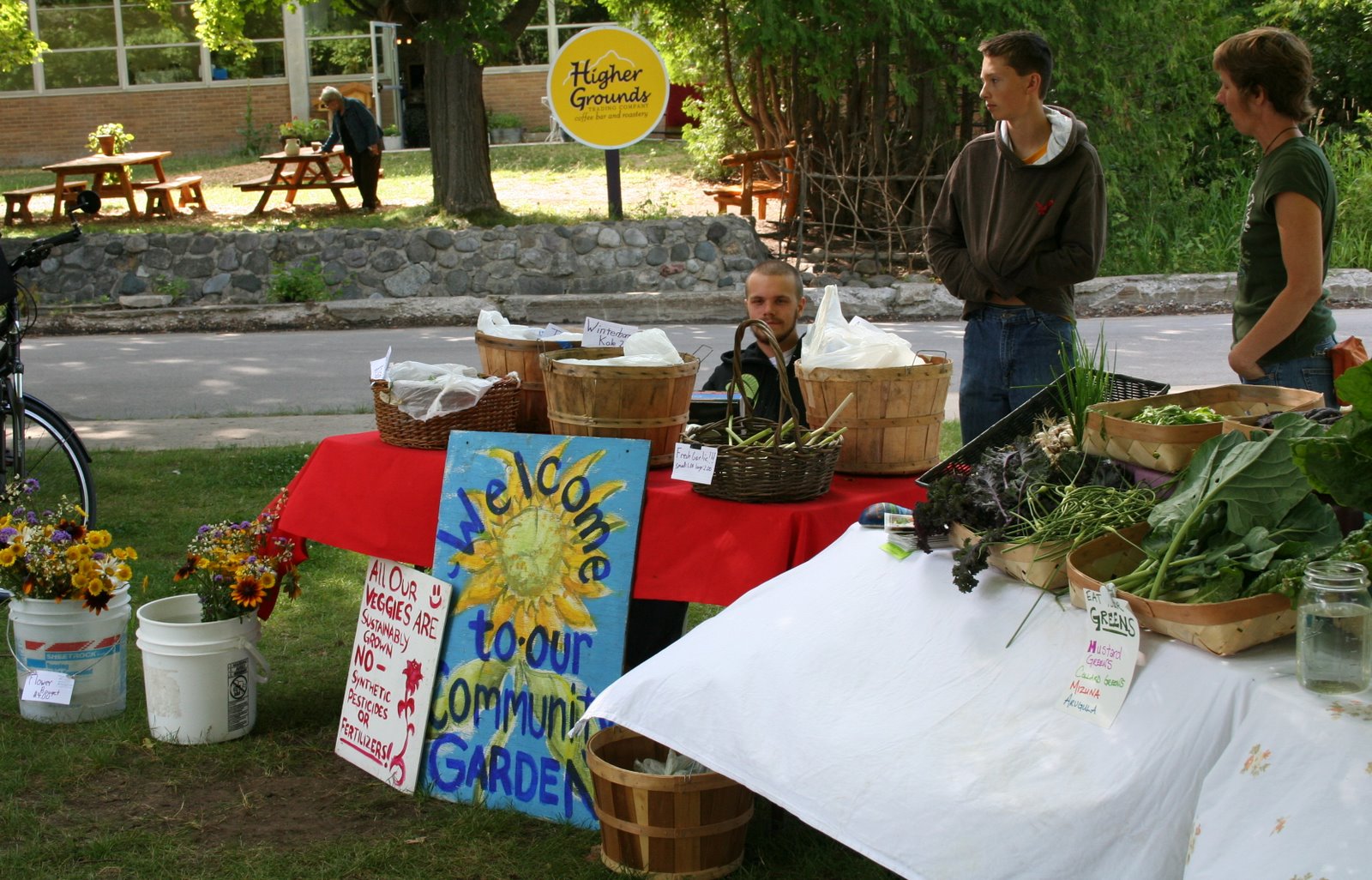
Check the photo I posted. This vendor at the TGIF Farmers Market (Village of Grand Traverse Commons) notes in one sign that the veggies are grown sustainably with “no synthetic pesticides or fertilizers.”
Which brings me to today’s CSA pickup. As I’ve noted every other week, I signed up for a half share this year at King’s Hill Farm, which does happen to advertise as organic.
A full share would give me more veggies than my family could eat. The half share provides a perfect balance of regular veggies I know I like and more exotic varieties that spark my creativity in the kitchen.
In this week’s box:
- Green Cabbage
- Summer Squash
- Sweet Onion
- White Baby Turnips
- Zucchini
- Cucumbers
- Kale Medley
- Basil
- Rainbow Chard
- Dill
- New Potatoes
- Green Beans
- Celery
- Cilantro
- Torpedo Onions
I’ll need to refer to my new Google Group – Cooking Away My CSA – to figure out what to do with the baby turnips and the kale. And good gravy, we got more dill than I’d ever know what to do with. Am thinking to start – lemon and dill broiled salmon. Can’t wait to get cooking.
 Virtual Farmgirl
National organic standards require that products bearing the organic label are made without the use of synthetic pesticides, fertilizers, genetic engineering, irradiation, artificial ingredients,and preservatives. Organic products must also promote and enhance biodiversity, biological cycles and soil biological activity, as well as “restore, maintain and enhance ecological harmony.” Together, these and other organic regulations offer consumers something that no other eco-label can provide: assurance that the organic products they buy and consume are produced and processed in a manner that not only promotes and protects environmental health, but also maintains product integrity that begins on the farm.
LikeLike
Absolute WORD on everything in this post. Besides, the best move for the planet is to always buy local and in season. You'll more likely than not get organic, but the fossil fuels you offset without the need for trucking something in will more than off-set the cost of a few pesticides.Our vineyard is being farmed organically, but it takes three years of pesticide free farming to get the certification. Even though we have land that has NEVER been farmed. We still wait three years. It's even longer and harder to be certified biodynamic, which we are currently doing.Oh and it was great meeting you at BlogHer.
LikeLike
I agree! It's best to ask how the food was grown for sale at the farm market. Some farmers grow using organic or at least sustainable methods but don't apply for the offical certification because of the expense and don't want to pass that along to their customers. By the same token, don't assume that everything for sale at a farmer's market was locally grown by the person running the market. Thanks for the new food labeling law, I noticed that the plums for sale at a farm market were in season but were shipped in from another state.
LikeLike
National organic standards require that products bearing the organic label are made without the use of synthetic pesticides, fertilizers, genetic engineering, irradiation, artificial ingredients,and preservatives. Organic products must also promote and enhance biodiversity, biological cycles and soil biological activity, as well as “restore, maintain and enhance ecological harmony.” Together, these and other organic regulations offer consumers something that no other eco-label can provide: assurance that the organic products they buy and consume are produced and processed in a manner that not only promotes and protects environmental health, but also maintains product integrity that begins on the farm.
LikeLike
Absolute WORD on everything in this post. Besides, the best move for the planet is to always buy local and in season. You'll more likely than not get organic, but the fossil fuels you offset without the need for trucking something in will more than off-set the cost of a few pesticides.Our vineyard is being farmed organically, but it takes three years of pesticide free farming to get the certification. Even though we have land that has NEVER been farmed. We still wait three years. It's even longer and harder to be certified biodynamic, which we are currently doing.Oh and it was great meeting you at BlogHer.
LikeLike
I agree! It's best to ask how the food was grown for sale at the farm market. Some farmers grow using organic or at least sustainable methods but don't apply for the offical certification because of the expense and don't want to pass that along to their customers. By the same token, don't assume that everything for sale at a farmer's market was locally grown by the person running the market. Thanks for the new food labeling law, I noticed that the plums for sale at a farm market were in season but were shipped in from another state.
LikeLike